
Noticias · November 23, 2026
Freshservice vs ServiceNow: decide with research, not a feature checklist
For IT leadership in Latin America, choosing between Freshservice and ServiceNow is not a battle of feature checklists, but a strategic calculation of operational maturity and total cost of ownership (TCO): while ServiceNow imposes a highly complex ecosystem and hidden consulting costs leading to chronic over-scoping, Freshservice delivers modern ITIL governance, accelerated deployment, and financial predictability without the technical debt penalty.
Gemini-assisted research · verified sources

| Topic | Freshservice + EFICSA | ServiceNow |
|---|---|---|
| Typical fit | Mid-size desk / ESM (≈200–5,000) | Multi-dept enterprise program |
| Time-to-value | Weeks with Care Plus | Months; depends on implementer |
| Pricing | Public Freshworks list + Care Plus | Quote-based; no public $/agent |
| Risk | Too light if you already run at SN scale | Overbuy if maturity lags features |
Freshservice manufacturer list (PDF 13 Jun 2025). Care Plus is an EFICSA offer, separate from the license.
1. The Latin American CIO's Dilemma: Operational Maturity vs. the Overbuying Trap
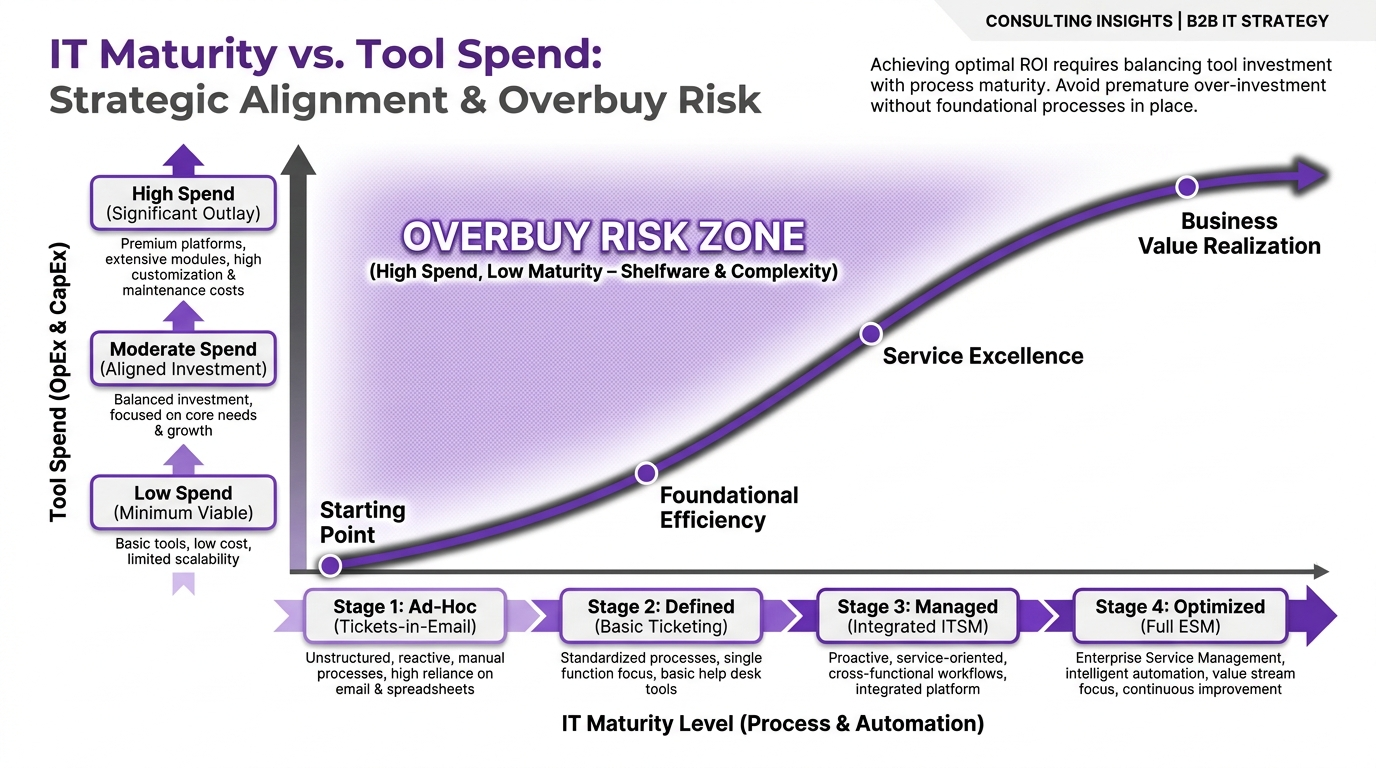
In the corporate context of Latin America, IT leaders face a dual mandate: modernizing service delivery under ITIL frameworks while enforcing strict control over operational expenditures (OpEx). All too often, organizations make the strategic misstep of selecting IT Service Management (ITSM) platforms engineered for multinational enterprises with internal armies of developers, under the flawed assumption that greater engineering density equates to higher service quality.
This disconnect between acquired capability and real business maturity results in what industry analysts call the 'overbuying trap.' According to Gartner findings analyzed by EasyVista in its 2025 report on the ITSM market, eight out of ten ITSM software buyers end up paying for complex features and advanced modules that they never configure or monetize in their daily operations.
Falling into this pattern is akin to walking into a dealership looking for a dependable fleet vehicle for urban corporate distribution and ending up persuaded to purchase a Formula 1 single-seater or a heavy mining haul truck. The over-engineered machine not only consumes an exorbitant amount of fuel and requires spare parts that take months to arrive, but it also demands certified mechanics just to change a tire. By the time the CIO manages to get the engine running, the department's budget has been mortgaged, and end users are still logging incidents through informal, unmanaged channels.
- Eight out of ten organizations (80%) pay a premium for service catalog, orchestration, and CMDB capabilities they never deploy, according to analyst projections for 2025.
- The gap between an organization's actual process maturity and the platform's rigidity creates immediate 'adoption debt' and technical team resistance.
- The success of an ITSM initiative across the region depends on service stabilization speed, not the theoretical volume of contracted APIs or sub-modules.
2. Decoding Online Comparisons: Commercial Bias, Marketing, and Technical Reality
When evaluating ITSM platforms online, executive committees routinely encounter analyst quadrants and comparison matrices presenting polarized perspectives. On one end, ServiceNow's marketing positions its platform as the 'operating system for global enterprise work,' aimed at massive conglomerates with virtually unlimited systems integration budgets. On the other end, user-driven review platforms such as Capterra and G2 reflect the daily, hands-on experience of system administrators and end users.
In Capterra's analysis of mid-sized teams implementing ITIL, Freshservice earns an ease-of-use rating of 4.76 out of 5, compared to 4.44 for ServiceNow. This 0.32-point usability delta is not a cosmetic detail: in the day-to-day operations of a shared services center or a regional IT department, it translates into hours saved on the learning curve, reduced friction when classifying tickets, and a substantial decline in misrouted requests.
Industry portals such as MigrateX and Rezolve.ai emphasize that the apparent functional parity shown in feature checklists conceals a critical architectural divide. While Freshservice was built from the ground up on a modern no-code/low-code configuration philosophy accessible to functional analysts, ServiceNow requires advanced JavaScript programming, complex relational table administration, and strict instance governance demanding full-time certified architects.
- Capterra ease-of-use rating for mid-sized teams: Freshservice outperforms ServiceNow at 4.76/5 versus 4.44/5.
- G2 and MigrateX comparisons reveal that user satisfaction with Freshservice centers on rapid time-to-value and operational self-sufficiency for IT analysts.
- ServiceNow reviews highlight its strength in ultra-complex enterprise workflows, but consistently warn of legacy administrative interfaces and steep learning curves.
3. Total Cost of Ownership (TCO) Teardown: Explicit Licensing vs. Hidden Costs
One of the most critical blind spots in enterprise technology procurement is restricting budget assessments strictly to the annual subscription cost. Freshworks maintains a completely public, transparent, and predictable pricing structure for Freshservice (ranging from its Starter plan at $19 per agent/month, Growth at $49, Pro at $99, to Enterprise (Contact Us), billed annually), empowering leadership to forecast the exact financial impact of headcount growth with mathematical certainty.
Conversely, ServiceNow does not publish per-agent pricing on its website nor maintain standardized public rate cards; its commercial model relies on opaque, highly customized enterprise quotes typically structured around minimum bundles, fulfiller licenses, and database capacity or transactional surcharges. These costs routinely surge at renewal periods without prior buyer visibility into pricing adjustment rules.
Licensing fees, however, represent only the tip of the TCO iceberg. According to industry benchmarks analyzed by Freshworks and Rezolve, for every dollar invested in ServiceNow licenses, organizations spend an average of $3 to $5 in professional implementation services, external integrators, and ongoing maintenance. With Freshservice, intuitive self-management slashes this professional services multiplier to a minimal fraction of the initial budget.
- Transparent Freshservice pricing with public tiers ($19, $49, and $99 annually; Enterprise Contact Us USD per agent/month) versus ServiceNow's opaque, customized pricing model.
- Implementation multiplier: ServiceNow frequently requires between 3x and 5x the license value in third-party consultants for deployment and ongoing tuning.
- Recurring support overhead: Freshservice enables internal maintenance by standard IT administrators, removing dependence on dedicated, high-cost certified ServiceNow architects.
4. Technical Decision Matrix: When Does ServiceNow Justify Its Cost, and When Is Freshservice the Optimal Path?
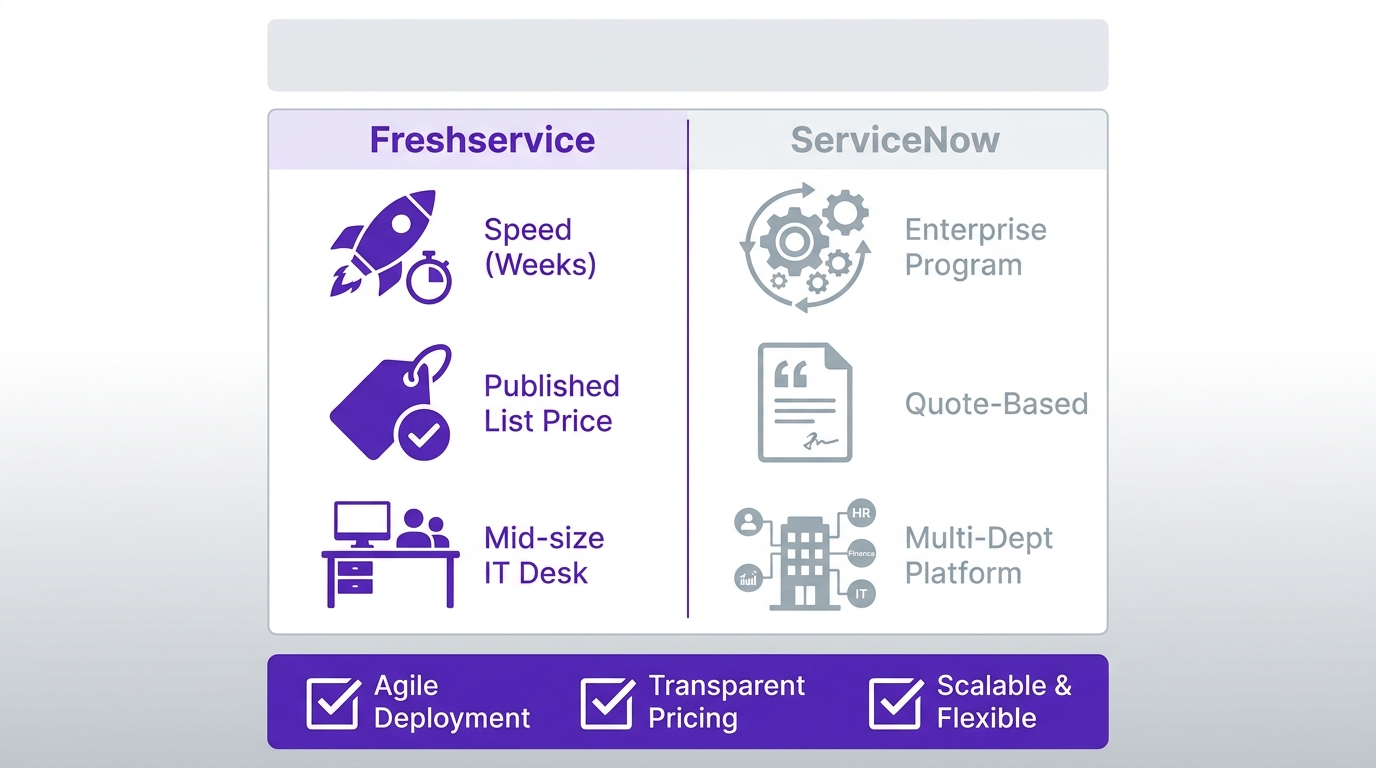
Evaluating both technologies with architectural integrity requires acknowledging that each has a legitimate footprint in the enterprise landscape. ServiceNow remains the undisputed benchmark for global conglomerates with over 10,000 employees, multinational banking institutions running legacy environments requiring mainframe orchestration, or organizations that must unify IT, human resources, governance, risk and compliance (GRC), and software engineering workflows into a single continental database.
For the remaining 90% of organizations in Latin America—including regional banks, retailers, industrial conglomerates, telecom operators, and service firms with 200 to 5,000 employees—ServiceNow's architecture represents unjustified structural overhead. Freshservice provides comprehensive coverage across core ITIL processes (Incident, Problem, Change, Release Management, Service Catalog, and integrated CMDB/ITAM with automated discovery) without requiring weeks of custom scripting to modify an approval workflow.
The decision framework ultimately centers on evaluating the opportunity cost of Time-to-Value. While a standard ServiceNow implementation takes between 6 and 18 months to conclude its initial operational phase, Freshservice deployments consistently reach full operational maturity within 4 to 12 weeks, enabling the CIO to demonstrate tangible ROI well before the close of the first fiscal cycle.
- Choose ServiceNow if: You have more than 10,000 users, an in-house JavaScript development Center of Excellence, and a strict requirement to unify GRC, HR, and SecOps within a single massive database.
- Choose Freshservice if: You require standardized ITIL 4 maturity, AI-driven self-service, modern IT asset management (ITAM), and measurable ROI in under 90 days.
- Delivery speed: Freshservice averages deployment cycles of 4 to 8 weeks, whereas ServiceNow averages implementation windows of 6 to 18 months.
5. ITIL Governance and Adoption Rates: The Risk of Bureaucratic Fatigue in Technical Teams
The real-world efficacy of any IT framework is fundamentally constrained by the adoption rate of the technicians who must log, document, and resolve service requests. A recurring hazard observed in mid-market and enterprise ServiceNow implementations is bureaucratic fatigue: overwhelmed by mandatory fields, dense administrative views, and sluggish transitions, infrastructure engineers and support agents often bypass the tool entirely, defaulting to informal channels to handle incidents.
Freshservice mitigates this friction by leveraging a consumer-grade user experience (UX) rooted in modern design standards. It natively embeds virtual agents powered by natural language processing alongside contextual automations that resolve recurring requests without manual intervention. Workflows are designed visually using intuitive drag-and-drop interfaces, empowering service desk leads to configure routing rules or adjust SLAs in minutes without submitting change requests to software development teams.
From an ITIL governance and Change Management perspective, Freshservice enables teams to map infrastructure dependencies and evaluate risk profiles seamlessly via its integrated CMDB. Unlike ServiceNow, where maintaining CMDB integrity frequently requires dedicated full-time personnel for ongoing discovery table reconciliation, Freshservice uses lightweight discovery probes and cloud connectors to keep hardware and software inventories accurate with minimal network overhead.
- Operational adoption: Freshservice's intuitive interface halts 'ticket leakage' into untracked WhatsApp messages, personal inboxes, or corporate chats.
- Visual change enablement: Streamlined Change Advisory Boards (CAB) with automated risk and impact evaluations requiring zero custom code.
- CMDB and Asset Management: Frictionless hybrid discovery that avoids the configuration and maintenance overhead typical of legacy Configuration Management Databases.
6. The Latin American Regional Factor: Time Zone Alignment and EFICSA's Care Plus Model
The success of an ITSM project in Latin America does not end with software procurement; it is determined by the quality and proximity of post-sales support. A persistent challenge with mega-vendors like ServiceNow is that their Tier 2 and Tier 3 engineering support centers are frequently situated in distant time zones (Europe or Asia-Pacific) or routed through generic tier-one brokers, meaning critical platform incidents can take days to escalate, disrupting sensitive commercial or banking operations.
Partnering with a certified technology provider operating natively in the same time zone—providing immediate response windows and specialists operating within direct, synchronized working hours—transforms business continuity. The capability to collaborate in the local language, navigate regional regulatory nuances, and conduct real-time troubleshooting prevents operational drift and desk fatigue.
This is where EFICSA's value-added model excels through its Care Plus program for Guatemala and Panama (GT/PA). The program provides 16 dedicated hours per month of specialized consulting, workflow optimization, proactive maintenance, and technical enablement. This ensures the ITSM platform matures in lockstep with corporate growth, shielding the CIO from costly change-order consulting fees for minor adjustments while maximizing long-term return on investment.
- Real-time alignment: Certified specialists operating within Central America and Caribbean working hours, eliminating operational shift gaps.
- Care Plus specialized support: 16 dedicated monthly hours of strategic consulting and continuous technical optimization across Guatemala and Panama through EFICSA.
- High-touch consulting: Direct advisory backing for audits, service catalog redesigns, and governance without dependence on billable-hour scopes from global consulting firms.
Practical checklist
- Audit your current process catalog to determine whether your actual ITIL maturity warrants complex custom engineering or immediate operational standardization.
- Require absolute pricing transparency in initial proposals, identifying whether the vendor publishes clear per-agent rates or mandates opaque enterprise bundling.
- Calculate the realistic 3-year and 5-year TCO multiplier by combining license costs with anticipated external consulting hours and internal developer payroll.
- Verify independent usability benchmarks (such as Freshservice's 4.76 vs. ServiceNow's 4.44 on Capterra) to anticipate organizational change resistance.
- Establish institutional Time-to-Value expectations, determining if the organization can absorb a 6-to-18-month deployment cycle or demands production readiness within 90 days.
- Assess vendor support availability to guarantee engineering assistance operates natively within Central America and Latin American business hours without escalation delays.
- Evaluate whether your regional implementation partner provides structured post-implementation support, such as EFICSA's Care Plus (16 hours/month of consulting in GT/PA), to ensure continuous platform evolution.
Sources and research
- EasyVista / Gartner (2025)
Eight out of ten organizations (80%) overpay for advanced ITSM capabilities that they never deploy due to the mismatch between software complexity and their actual operational maturity.
- Capterra (2024)
In ease-of-use ratings for mid-sized teams implementing ITIL, Freshservice achieves an average score of 4.76 out of 5 compared to ServiceNow's 4.44 out of 5.
- MigrateX (2024)
Technical reviews and G2 comparison data underscore Freshservice's advantage in deployment speed and lower reliance on specialized JavaScript developers for day-to-day administration.
- Freshworks Compare (2024)
Comparative TCO analysis demonstrating how ServiceNow's professional services costs substantially inflate overall project budgets compared to Freshservice's no-code architecture.
- Rezolve.ai (2024)
Assessment of hidden operational costs and support agility documenting the heavy administrative overhead of ServiceNow instances versus Freshservice's agile, conversational AI-driven self-service.
- Freshworks Pricing (2025)
Public, transparent pricing tiers for Freshservice including Starter ($19), Growth ($49), Pro ($99), and Enterprise (Contact Us) billed annually, contrasting with ServiceNow's opaque pricing structure.